
What Determines the MOQ for Custom Camping Products?
Learn how fabric orders, colors, components, tooling, branding, packaging and production economics determine MOQ for custom camping products.
Published July 16, 2026
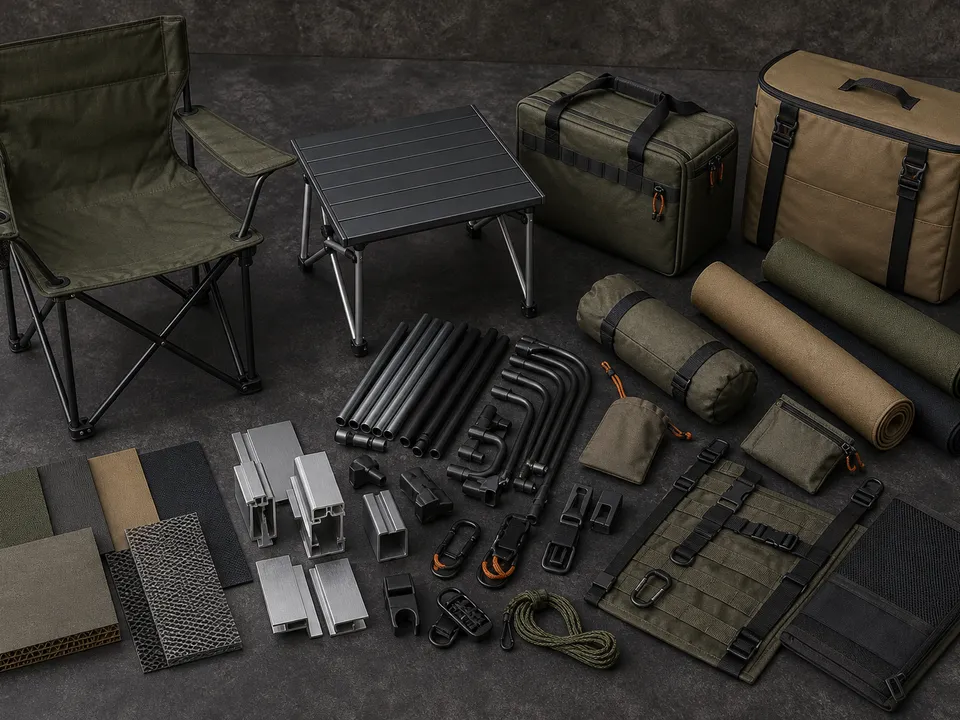
MOQ—minimum order quantity—is not just a factory preference. For custom camping products, it usually reflects the smallest economical commitment across materials, components, production setup and packaging.
Understanding those drivers helps buyers negotiate the right variable instead of simply asking for a lower number.
Fabric and material minimums
Custom fabric color, coating, print or weight can trigger a mill minimum that is larger than the number of finished products you initially want.
A factory may be able to use the remaining material in a later order, but that creates inventory, shade and storage questions. Alternatively, selecting an available stock color can reduce the material commitment.
Ask whether the quoted MOQ comes from the factory, fabric mill, finish supplier or another component source.
Components and tooling
Buckles, molded parts, custom hardware, printed trims and branded accessories may each have independent minimums.
Custom tooling does not automatically create a high unit MOQ, but the setup, changeover and per-run economics still matter. For a new molded component, buyers should separate tooling cost from the quantity needed for an efficient production run.
Color and SKU fragmentation
An order of 1,000 units split across five colors is operationally different from 1,000 units in one color.
Each variant may require separate material allocation, line setup, labels, packaging, inspection and carton control. A supplier may quote:
- A total order MOQ
- An MOQ per color
- An MOQ per style
- A minimum production value
Confirm which rule applies before planning the assortment.
Branding and packaging
Woven labels, printed boxes, manuals, sleeves and header cards have their own order economics. Digital printing or neutral packaging with a brand sticker can sometimes support a pilot run, while full custom packaging is introduced after demand is proven.
This should be a deliberate brand decision. Lower-quantity packaging should still look intentional and meet market requirements.
Product complexity and setup time
A product with many assembly steps, fixtures or quality checks has a higher cost to start and stop. Very small runs may be possible at a higher unit price because setup is spread across fewer products.
Rather than treating that price as a penalty, compare it with the financial risk of buying excess inventory.
Practical ways to reduce initial commitment
Buyers can often improve MOQ by:
- Using existing material colors or finishes
- Sharing components across a product range
- Limiting the first launch to fewer SKUs
- Simplifying packaging for a pilot
- Paying a small-run production surcharge
- Scheduling production alongside a compatible material order
Not every option applies to every product. The manufacturer should identify which constraint is actually driving the quantity.
Ask for a transparent MOQ explanation
A useful quotation separates product MOQ, color MOQ, material commitment, packaging MOQ and tooling. It also explains what changes when the quantity rises.
For more context, explore our camping equipment capability or submit a project brief with your expected quantity and customization priorities.