
How to Choose a Reliable Camping Gear Manufacturer
A practical framework for evaluating camping gear manufacturers across capability, sampling, quality control, communication and commercial fit.
Published July 24, 2026
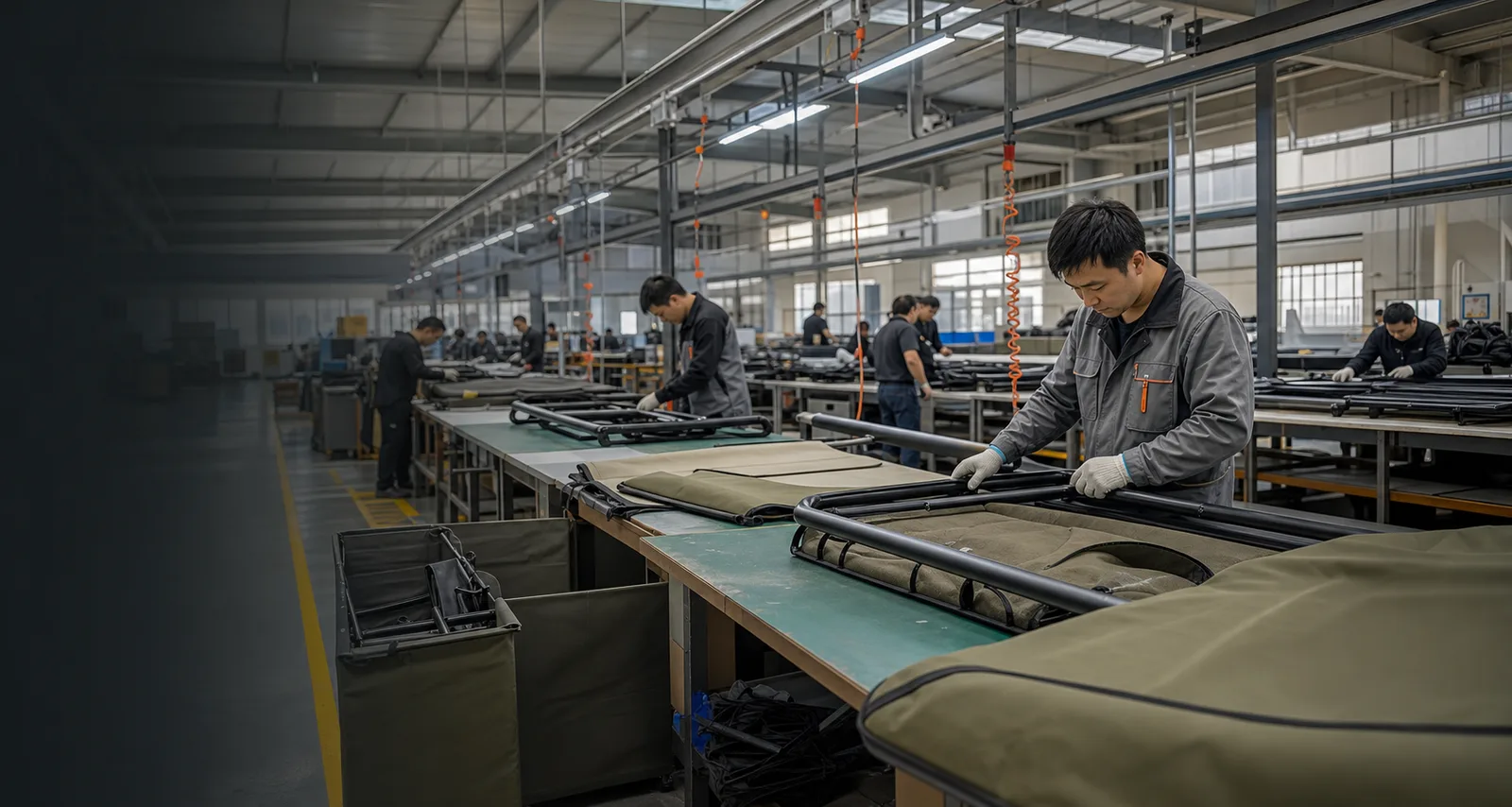
Choosing a camping gear manufacturer is not mainly a search for the lowest unit price. It is a risk decision involving product performance, launch timing, brand reputation and working capital.
A useful evaluation process separates evidence from sales language. The supplier should be able to explain how your product moves from brief to sample, from approved sample to production, and from production to inspection.
Start with product-process fit
“Outdoor equipment” covers very different processes. A supplier that performs well with sewn storage bags may not be the right partner for load-bearing camp furniture or multi-material products.
Ask which parts of the proposed product are made, assembled or sourced through the supplier’s production system. For a camping chair, that may include technical textile work, tube forming, surface finishing, molded components, assembly and packaging.
The goal is not to demand that every operation happen under one roof. The goal is to understand who controls each operation and how the final specification stays consistent.
Review the sampling process
A reliable sampling plan states what each sample is intended to prove.
- A visual sample may confirm size, color and general construction.
- A functional sample may confirm handling, assembly or load requirements.
- A pre-production sample should represent the materials, branding and packaging intended for the order.
Ask how comments are recorded and how the approved result becomes the production reference. A casual message thread is not enough for a complex product. Drawings, a specification sheet, an approved sample and a change log create a stronger control system.
You can review our OEM and ODM development process for an example of clear approval gates.
Compare quotations on the same basis
Two quotations may look similar while assuming different fabric weights, coating levels, frame materials, testing, packaging or inspection.
Create a comparison sheet that includes:
- Material and construction assumptions
- Included branding methods
- Tooling and sample charges
- MOQ by color and product
- Packaging specification
- Production lead time and its starting point
- Inspection criteria
- Delivery terms
If a quotation leaves important fields open, treat the price as provisional.
Test communication before the order
Supplier communication is part of manufacturing capability. During quotation and sampling, note whether the team identifies missing information, explains trade-offs and confirms changes in writing.
A good response does not always say yes. Sometimes the most valuable answer is that a material, construction or deadline creates an avoidable risk.
Verify quality control with real documents
Do not stop at “we have strict QC.” Ask what is checked at material intake, first article, during production and before shipment.
Inspection criteria should reflect the product. A soft accessory may focus on dimensions, seams, appearance and packaging. Camp furniture may also require frame alignment, assembly, stability and project-specific load testing.
Read our camping equipment quality checklist and factory quality approach for a practical starting point.
Make the final decision on total project risk
The best manufacturing partner is the one whose capability, commercial model and working method fit the product you are building. Evaluate the supplier’s ability to surface risk early, maintain the approved specification and communicate when reality changes.
That discipline is usually worth more than a small difference in an incomplete first quotation.