
US and EU Compliance for Imported Camping Products
A practical starting framework for outdoor brands mapping US and EU product safety, chemical, labeling and documentation requirements before production.
Published July 26, 2026
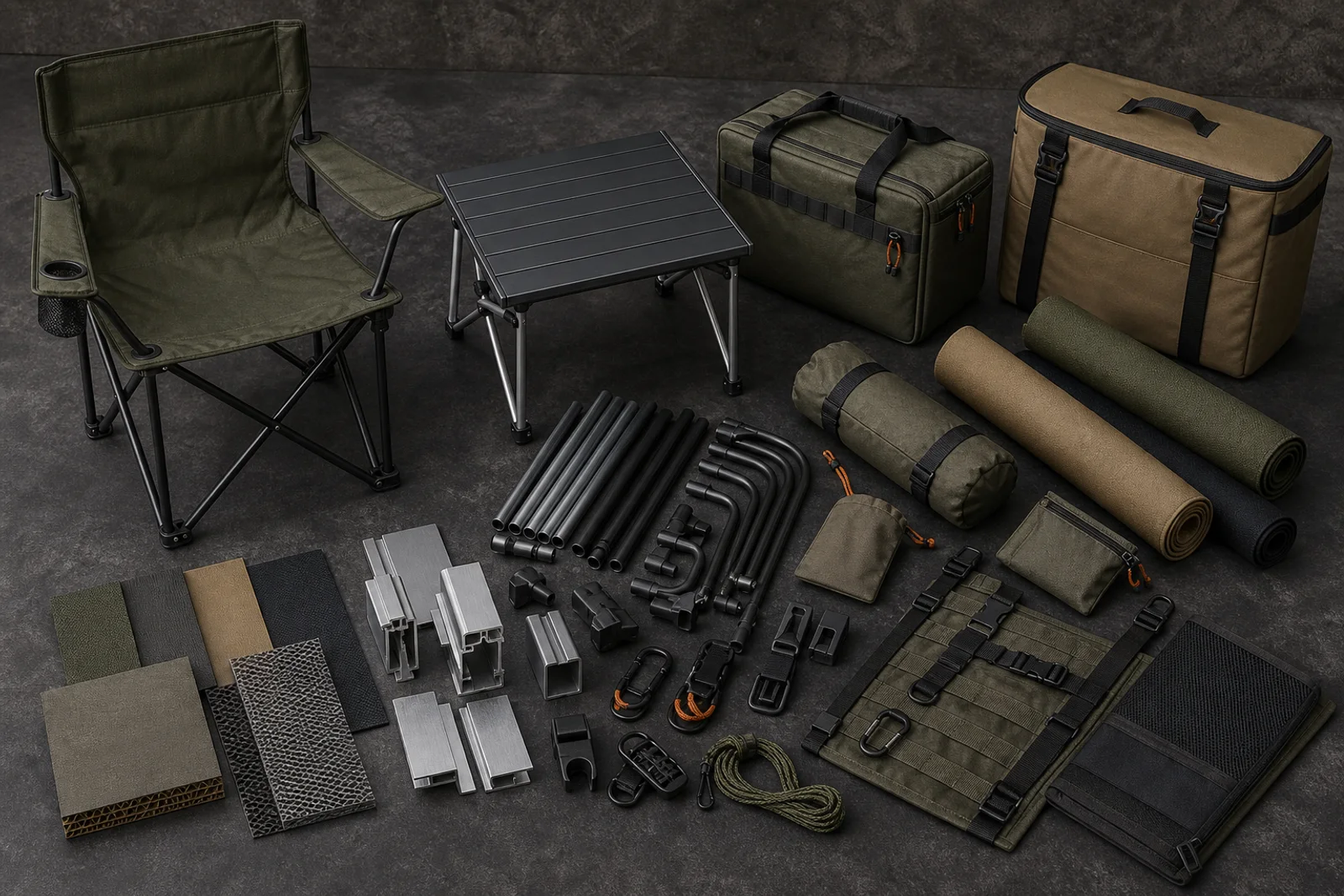
Compliance for camping products is not a single certificate. It is a product-specific system covering design, chemical restrictions, testing, traceability, labels, instructions and technical records.
The correct requirements depend on what the product is, who will use it, how it is marketed and where it will be sold. A textile storage bag, folding chair, electrical lantern and children's sleeping product can fall under very different rules.
This article is a sourcing framework, not legal advice. Confirm the final requirement matrix with qualified compliance professionals and the authorities or retailers in your destination market.
Classify the product before requesting tests
Write a clear product description that includes:
- Intended use and reasonably foreseeable misuse
- Intended user and age range
- Materials and components
- Mechanical, electrical, chemical or flame-related hazards
- Claims made on the product page or packaging
- Sales countries and channels
- Whether the product is part of another regulated system
Do not begin with “Which certificate can the factory provide?” Begin with “Which rules apply to this exact product?”
Build a US compliance map
In the United States, the Consumer Product Safety Commission provides business guidance for consumer product safety requirements, recalls, testing and certification. Applicable federal rules vary by category.
Important workstreams may include:
Product safety
Assess mechanical hazards such as instability, entrapment, sharp points, structural failure and foreseeable misuse. Products for children may trigger additional requirements and third-party testing obligations.
Textile labeling
Textile products may be subject to fiber-content, country-of-origin and responsible-company labeling rules. The US Federal Trade Commission publishes a detailed Textile and Wool Acts labeling guide.
State requirements
State rules can add obligations. California Proposition 65 is a common example that requires a separate exposure-based assessment rather than a generic logo on every product.
Claims and instructions
Performance claims such as load, water resistance or flame behavior should be supported by an appropriate method and sample. Warnings should not be used as a substitute for a reasonably safe design.
Build an EU compliance map
The EU General Product Safety Regulation, Regulation (EU) 2023/988, applies to consumer products within its scope and has applied since 13 December 2024. The official text is available through EUR-Lex.
For a non-food consumer product, the compliance review may include:
- Product safety assessment
- Manufacturer, importer and EU responsible economic operator information as applicable
- Product identification and traceability
- Safety instructions and warnings in required languages
- Technical documentation
- Processes for complaints, incidents and corrective action
- Information presented in distance sales
CE marking is not universal
CE marking is required only when the product falls under EU legislation that mandates it. Electrical equipment, radio-enabled products or personal protective equipment may require a CE conformity route; an ordinary non-electrical camping accessory may not.
Use the European Commission's CE marking guidance to understand the principle, then identify the specific legislation for the product. Applying a CE mark without a valid basis is not a shortcut.
REACH and chemical restrictions
The EU REACH framework can restrict chemicals in articles and create communication or notification duties for certain substances. Review materials, coatings, inks, adhesives, metal finishes and plastic components against the current requirements and your customers' restricted-substance lists. Start with the European Chemicals Agency's REACH guidance.
Create a requirement matrix
Use one controlled table for each SKU:
| Field | Example of what to record |
|---|---|
| Market | US, EU countries and specific retail channels |
| Product classification | Adult folding camp chair, non-electrical |
| Applicable rules | Product-specific federal, EU and national requirements |
| Standards or methods | The exact edition and clause where relevant |
| Required evidence | Risk assessment, report, declaration, label review |
| Responsible party | Brand, importer, factory, laboratory or EU operator |
| Sample identity | Model, materials, components and revision tested |
| Production control | How conformity is maintained after approval |
Do not copy the matrix from a different product simply because both are called camping gear.
Verify reports before relying on them
Check:
- Applicant and manufacturer identity
- Product name, model and photographs
- Material and component details
- Test methods and editions
- Results, deviations and excluded items
- Laboratory identity and accreditation scope where relevant
- Report date
- Whether the mass-production product still matches the sample
A report for one fabric color, coating or construction may not automatically cover every variation.
Connect compliance to OEM development
Compliance decisions affect the bill of materials, structure, labels, instructions and packaging. Add compliance gates to the OEM development process:
- Initial classification before quotation
- Requirement review before material approval
- Development testing before design freeze
- Label and document review before production
- Production-representative testing where required
- Final inspection against identification, warnings and packaging
Changing a critical material after testing should trigger an impact review.
Prepare an evidence file
Keep a controlled file for each product containing the specification, risk assessment, drawings, bill of materials, test reports, declarations, label artwork, instructions, supplier information, inspection records and change history.
The goal is not paperwork for its own sake. The file connects the approved design to the product placed on the market.
Our outdoor equipment testing guide explains how to turn identified risks into a test plan. If you are preparing an OEM brief, include destination markets in your inquiry so compliance is discussed before the sample is treated as final.