
Essential Product Testing for Outdoor Equipment
Build a risk-based outdoor equipment test plan covering materials, construction, function, durability, packaging and production conformity.
Published July 26, 2026
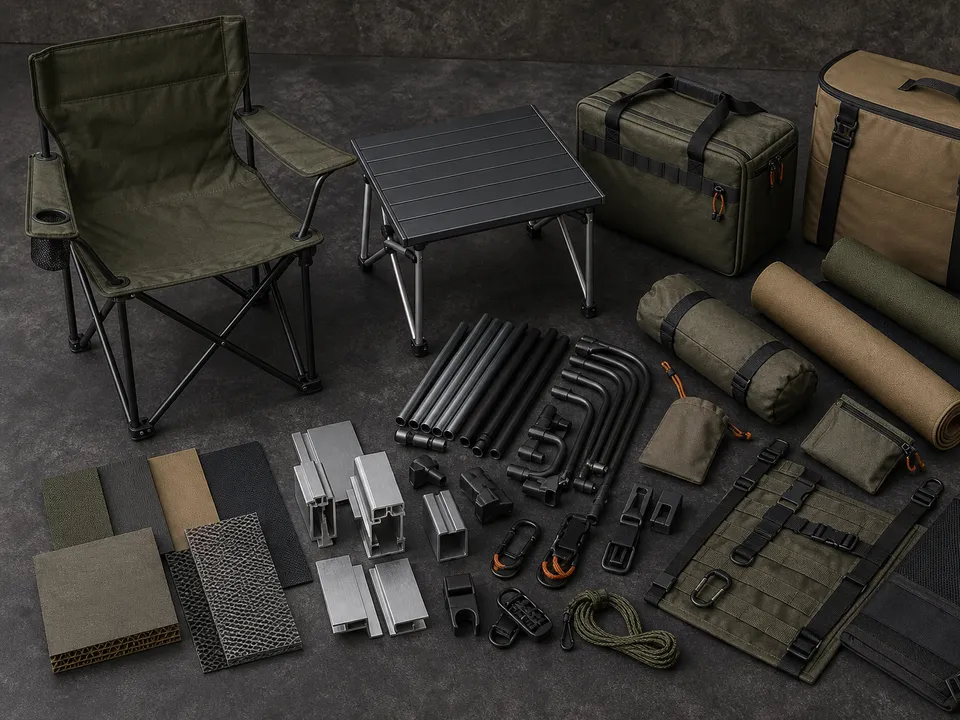
Outdoor product testing should begin with risk, not with a generic laboratory package. A good test plan asks what can fail, how the user could be affected and what evidence is needed before the product is released.
The result is usually a combination of design verification, material tests, production checks and final inspection—not one certificate.
Define the product and its claims
Record:
- Intended user and environment
- Setup and operating method
- Working loads or capacities
- Expected weather exposure
- Materials and critical components
- Destination markets
- Retailer requirements
- Marketing claims
- Foreseeable misuse
A claim such as “waterproof,” “UV resistant” or “supports 150 kg” needs a defined method and acceptance criterion. Without them, the claim cannot be verified consistently.
Use a risk-based test matrix
For each risk, connect four items:
| Risk | Verification | Sample stage | Acceptance criterion |
|---|---|---|---|
| Frame collapse | Static and repeated load assessment | Development and production | Project-specific requirement |
| Water ingress | Material and/or assembled-product exposure | Material approval and sample | Defined leakage limit |
| Seam failure | Seam strength or functional loading | Development and incoming control | Approved specification |
| Missing hardware | Pack-out and count check | Final inspection | No missing required components |
This structure prevents a long test list that misses the product's most important failure mode.
Test materials before they become finished goods
Possible textile properties include:
- Fiber composition
- Fabric weight and construction
- Tensile and tear performance
- Abrasion
- Colorfastness
- Coating adhesion
- Water resistance
- Dimensional change
- Restricted substances
Metal and plastic components may require checks for grade, dimensions, finish, corrosion, impact, temperature or chemical restrictions.
Select only properties relevant to the specification. A material data sheet can support selection, but it may not prove that the delivered batch or finished construction performs the same way.
Test the assembled product
Assembly creates risks not visible in component reports. Joints, seams, fasteners and geometry determine how load moves through the product.
Depending on category, functional testing may cover:
- Stability
- Static loading
- Cyclic or repeated operation
- Setup and fold mechanisms
- Pinch, sharp-edge and entrapment review
- Component retention
- Packed and deployed dimensions
- Water exposure
- Wind response under a defined method
- Usability of instructions and warnings
Do not apply a test method outside its intended scope simply because it produces a desirable number.
Distinguish development tests from compliance tests
Development tests help compare constructions and find weaknesses. They may use prototypes, internal fixtures or accelerated conditions.
Compliance testing demonstrates conformity to an applicable requirement and may need a defined laboratory, sample selection, report format or certification process.
Production-control tests confirm that bulk output continues to match the approved product. They should be practical enough to run at an appropriate frequency.
All three have value, but they are not interchangeable.
Select applicable standards carefully
Product standards can be category- and market-specific. Examples may exist for camping tents, sleeping bag thermal performance, outdoor furniture, electrical equipment and children's products.
Confirm:
- The standard applies to the product
- The correct edition is used
- National or retailer variations are considered
- The laboratory's scope is appropriate
- Marketing claims match what the method actually measures
For market requirements, begin with the US and EU compliance guide.
Approve representative samples
The tested sample should be traceable to the specification. Record model, size, materials, color or coating where relevant, component sources and revision.
If the production product changes after testing, conduct an impact review. A change in fabric coating, tube wall, buckle resin, adhesive or electronics may affect previous evidence.
For high-risk or required tests, consider how samples are selected. A factory-prepared “golden sample” may not represent normal production unless selection is controlled.
Connect testing to quality control
Not every laboratory test can be repeated on every unit. Convert critical requirements into factory controls.
Examples:
- Verify material identity at incoming inspection
- Use a go/no-go fixture for a critical dimension
- Approve the first unit after line setup
- Perform a defined load or function check by lot
- Check packaging content and labels during final inspection
- Schedule periodic external retesting
The camping equipment quality checklist shows how these controls fit into production.
Include packaging performance
Outdoor products can be heavy, long or full of hard components that damage one another in transit. Packaging validation may include drop, vibration, compression and conditioning based on the distribution journey.
The International Safe Transit Association provides recognized packaged-product testing procedures. Choose the method that matches the shipping environment and customer policy.
Inspect the product after the test, not only the carton.
Review failures as design information
A failed test is useful if it leads to a controlled decision. Record:
- Failure mode and location
- Test conditions
- Sample revision
- Immediate containment
- Root-cause analysis
- Proposed correction
- Retest requirement
- Effect on related products or open orders
Avoid changing several variables at once. Otherwise, the team may not know which change resolved the issue.
A practical test-plan workflow
- Classify the product and market
- Identify hazards and claims
- Select applicable requirements and methods
- Define sample stages and acceptance criteria
- Test critical materials and prototypes
- Close design issues
- Test a production-representative sample where required
- Translate requirements into factory controls
- Verify bulk production and packaging
- Retest after relevant changes or at a risk-based interval
Testing is most effective when planned during prototype development, not added just before shipment. For a product-specific review, share the category, use case and destination market.