
Best Materials for Custom Outdoor Equipment: A Buyer's Guide
Compare common fabrics, metals, plastics, coatings and hardware for custom outdoor products using performance, cost, compliance and supply criteria.
发布于 2026年7月26日
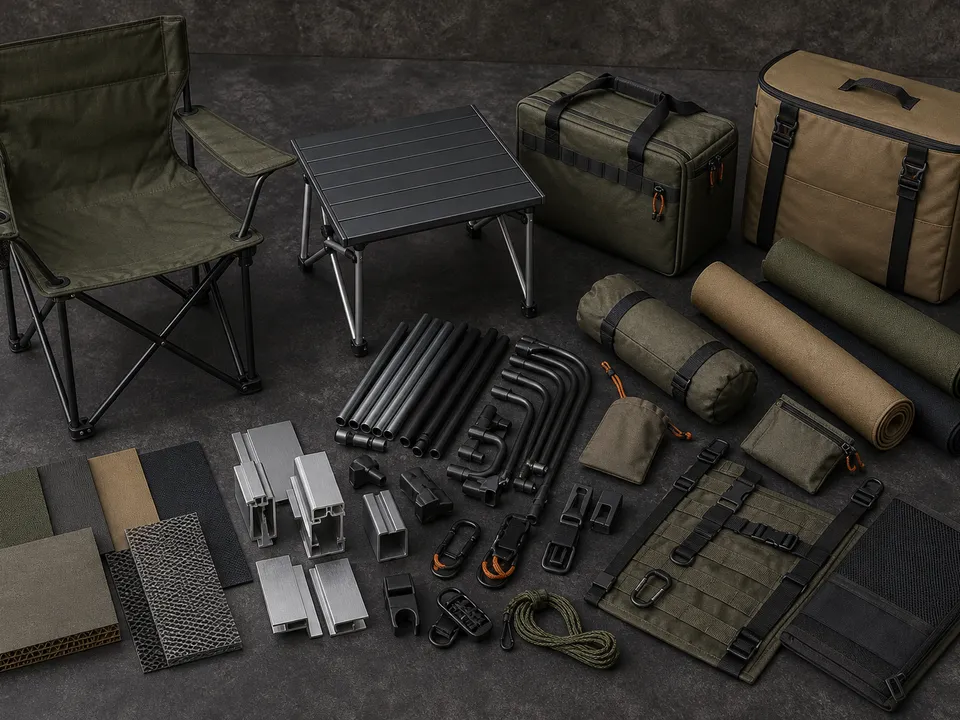
There is no single “best” outdoor material. The right choice balances use conditions, product life, weight, appearance, compliance, supply stability and target cost.
A material decision should begin with the product requirement, not a catalog swatch. The same fabric that works for a storage bag may be unsuitable for a shelter, load-bearing seat or long-term outdoor cover.
Write the performance brief first
Define the conditions the product must tolerate:
- Indoor storage or continuous outdoor exposure
- Rain, ground moisture or water pressure
- Sunlight and temperature range
- Abrasion, folding and repeated setup
- Static or dynamic loading
- Contact with food, skin or children
- Cleaning method
- Target service life
- Packed weight and size limits
- Destination-market restrictions
Then rank the requirements. A low packed weight may conflict with maximum abrasion resistance. A soft hand feel may conflict with a heavy protective coating.
Polyester and nylon fabrics
Polyester is widely used in tents, bags, covers and furniture because it can offer a practical combination of strength, dimensional stability, printability and cost. Nylon can provide high strength relative to weight and is common where packability and tear performance matter.
Do not specify either fiber by name alone. Review:
- Yarn denier or linear density
- Fabric weight
- Weave or knit construction
- Tear and tensile targets
- Abrasion requirement
- Coating or lamination
- Water-repellency finish
- Colorfastness
- UV exposure expectations
Two “600D polyester” fabrics can behave differently because the yarn, backing, weave and finishing are not the same.
Canvas and blended fabrics
Cotton canvas and polyester-cotton blends can provide a natural appearance, breathable feel and premium position for certain shelters, bags and campsite products. They are generally heavier and may require careful control of shrinkage, mildew risk, water-repellency treatment and drying instructions.
If a product will be packed while damp, material choice should be supported by clear care guidance and realistic use testing.
Mesh, webbing, thread and small textile components
The main shell is only one part of a sewn product. Failures often occur at attachments.
Specify mesh opening and strength for the intended use. Match webbing width, thickness and construction to the load path. Select sewing thread based on seam construction, exposure and strength needs. Zippers, hook-and-loop, elastic and binding also require controlled references.
Evaluate the complete seam and attachment, not the component data sheet in isolation.
Aluminum and steel
Aluminum is useful when weight, corrosion resistance and appearance are priorities. Steel can provide stiffness and strength at a competitive material cost but may add weight and require reliable corrosion protection.
For frames and hardware, define:
- Alloy or material grade where necessary
- Tube profile and wall thickness
- Temper or forming requirement
- Welding or fastening method
- Surface finish
- Corrosion-resistance expectation
- Critical dimensions and tolerances
- Load and cycle requirements for the assembled product
A thicker tube is not automatically a better design. Geometry, joint design, material condition and load direction also matter.
Engineering plastics and elastomers
Plastics are used for connectors, feet, buckles, handles and molded housings. The correct polymer depends on impact, stiffness, temperature, UV exposure, chemical contact and appearance.
Ask whether the production resin is virgin, recycled or blended and how the composition will be controlled. Color masterbatch, fillers and recycled content can affect performance. A molded component should be evaluated as part of the assembly, including stress concentration and fastening.
Coatings, finishes and adhesives
Water resistance, corrosion protection and surface appearance often depend on a finish rather than the base material alone.
Common systems include polyurethane or other fabric coatings, powder coating, anodizing, plating, paint, adhesives and seam-sealing materials. Define the required outcome and confirm that the process is compatible with the substrate.
Chemical restrictions differ by market and product type. Build a restricted-substance requirement around the destination market, retailer policy and intended use rather than requesting a generic “eco-friendly” certificate.
Compare materials through a decision matrix
For each candidate, score the criteria that matter:
| Criterion | Questions for the supplier |
|---|---|
| Performance | Which test data supports the intended claim? |
| Consistency | Is the material a standard construction with a controlled code? |
| Availability | Is it stocked, made to order or dependent on a high mill MOQ? |
| Appearance | How are color, texture and finish approved? |
| Compliance | Which declarations or test reports are required for the destination market? |
| Cost | What is the effect on unit price, MOQ and waste? |
| Repair and end of life | Can parts be replaced or materials separated? |
This turns “premium material” into a traceable decision.
Approve the production material
Use a labeled swatch, supplier specification and approved sample. Record any approved range for color or texture. If the material source changes, require notification and review before use.
Bulk material can vary from a small sample. For critical properties, define incoming checks or batch testing and connect them to the product testing plan.
Avoid five common specification mistakes
- Selecting only by material name
- Copying a competitor claim without knowing the test method
- Prioritizing one headline property while ignoring seams and joints
- Approving a sample made from a substitute without recording it
- Changing material after testing without reviewing the impact
Our camping equipment and outdoor accessories pages show where material choices typically enter an OEM brief. For a project-specific comparison, send the product use case and priorities.