
How to Audit an Outdoor Equipment Factory in China
A practical factory audit framework for outdoor brands evaluating production capability, quality systems, subcontracting and order risk in China.
Published July 26, 2026
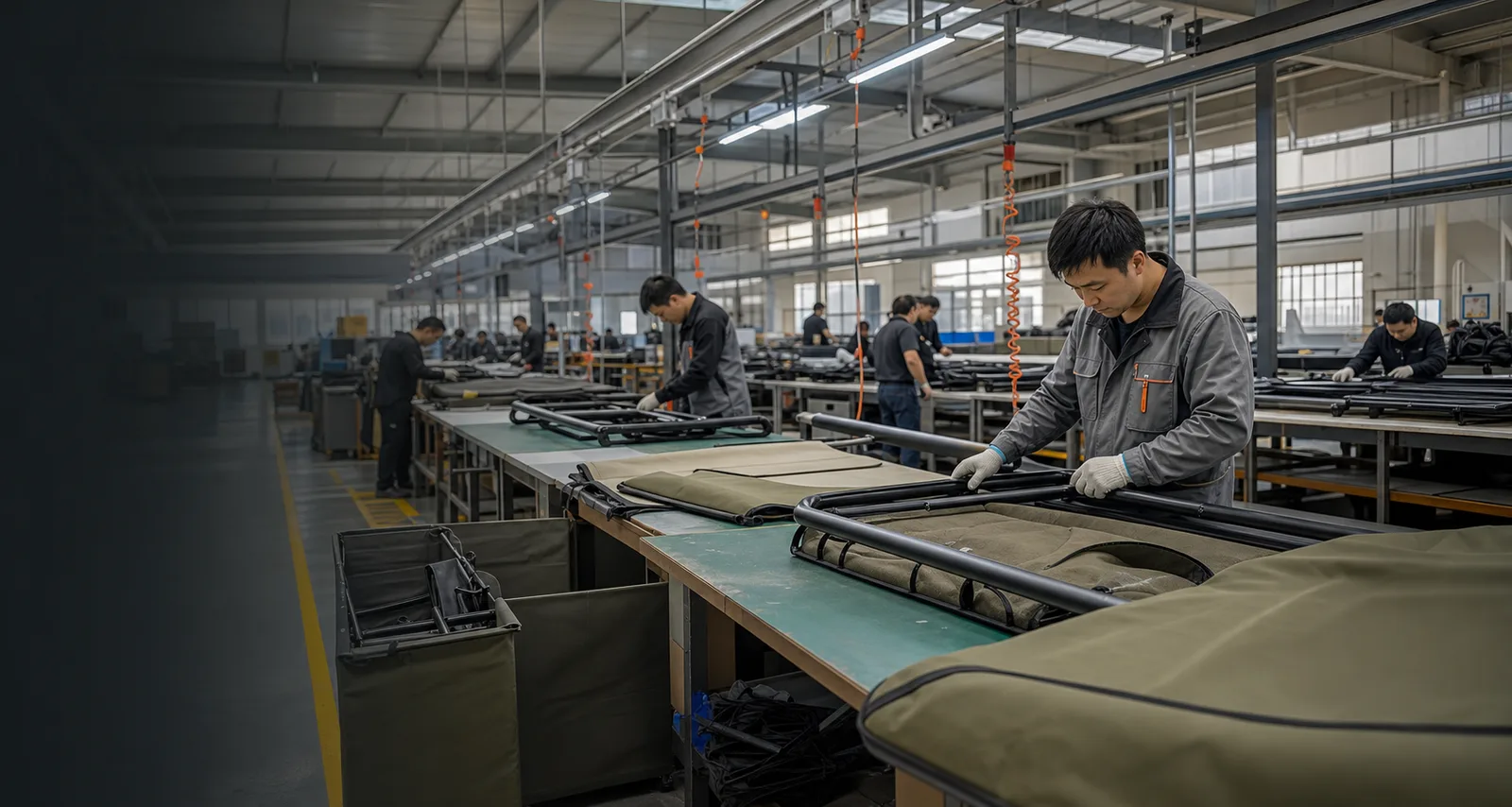
A factory audit should answer one commercial question: can this supplier repeatedly make your product to the approved specification, at the expected volume, without hiding risks?
Clean floors and modern machines are useful observations, but they do not prove process control. Outdoor products often combine textiles, metal frames, molded parts, coatings, hardware and retail packaging. Your audit therefore needs to follow the product through the system rather than score the building alone.
Define the audit scope before the visit
Start with the proposed product, destination market and order plan. A sewn organizer does not require the same review as a folding chair, roof-mounted accessory or product intended for children.
Send the factory a short agenda covering:
- Product families and processes in scope
- Expected order quantity and peak demand
- Critical materials and performance requirements
- Destination markets
- Required testing, labeling and packaging
- Operations that may be subcontracted
Ask for a process flow before the audit. This gives you a reference against which to compare what you actually see.
Confirm that the factory matches the quotation
Verify the legal company name, production address, main product categories and the team responsible for your order. Then compare the quoted manufacturing story with the factory floor.
For example, if a supplier describes itself as a camping furniture manufacturer, look for evidence relevant to that work: incoming tube or fabric checks, cutting and forming, welding or fastening controls, finishing coordination, assembly fixtures and final inspection. The exact process mix varies, but the explanation should be consistent.
Do not reject a factory simply because it outsources a process. Instead, determine whether critical suppliers are approved, specifications are transferred clearly and incoming components are verified.
Review capacity using evidence, not a headline number
Published monthly capacity can be misleading when it combines different products or assumes ideal conditions. Ask the operations team to explain capacity for a product similar to yours.
Useful evidence includes:
- The number of relevant production lines or workstations
- Normal shifts and available labor
- Output per line for a comparable construction
- Current order loading
- Known bottlenecks such as coating, printing or assembly
- The plan for seasonal peaks
Capacity should also be checked against material lead time. A sewing line may have room while custom fabric, hardware or printed packaging is still weeks away.
Trace one product from incoming material to shipment
Choose a current product and follow its records. Look for a connection between the customer specification, bill of materials, approved sample, work instructions and inspection criteria.
At incoming inspection, ask how the team identifies materials and prevents an unapproved substitute from entering production. During production, review first-article approval and in-process checks. At final inspection, compare the checklist with the product's actual risks.
A useful audit does not ask only, “Do you inspect?” It asks:
- What is inspected?
- Who performs the check?
- How often is it checked?
- What record is created?
- What happens when the result fails?
Our camping equipment quality control checklist provides a product-focused companion to this audit.
Examine change and nonconformance control
Outdoor products frequently change during sampling. Materials become unavailable, tolerances are adjusted and packaging is revised. The factory needs a controlled way to prevent old information from reaching production.
Ask for an example of a recent specification change and how it was communicated. Then ask for a nonconformance record. A mature response should show containment, disposition and corrective action appropriate to the issue.
Be cautious if failed material is mixed with approved stock, rework is not identified or changes are confirmed only through informal chat messages.
Review testing capability honestly
In-house fixtures can be valuable for development and production checks, but they are not automatically equivalent to an accredited laboratory report. Record what the equipment measures, how it is maintained and whether the method matches your requirement.
For a camp chair, project-specific checks might include dimensions, stability, assembly, static loading and repeated operation. For a textile accessory, they may include seams, color, coating, water resistance or abrasion. The correct plan depends on product claims and destination rules.
Use independent laboratories where regulation, retailer policy or a high-risk claim requires it. See our outdoor equipment testing guide for a risk-based testing structure.
Check social, safety and certification claims
If a supplier presents an audit report or certificate, verify the company name, address, scope, issuing body and validity. A certificate for a different site or product does not prove your project is covered.
Also review basic workplace and fire safety, chemical storage, personal protective equipment and emergency access. These conditions affect continuity as well as responsible sourcing.
Turn findings into a sourcing decision
Classify findings by risk:
- Critical: a legal, safety or integrity issue that blocks approval
- Major: a system gap that could affect product conformity or delivery
- Minor: a limited issue that should be corrected and monitored
- Observation: an improvement opportunity
Request evidence for corrective actions and set a deadline. Supplier approval can be conditional, product-specific and limited to an initial order.
The audit is one part of qualification. Combine it with sample performance, communication quality, commercial terms and a controlled first production run. If you are planning a new program, review our OEM and ODM process or send the project scope for discussion.