
Key Cost Factors in Custom Outdoor Product Manufacturing
Understand the material, labor, tooling, testing, packaging and order variables that shape quotations for custom outdoor products.
发布于 2026年7月26日
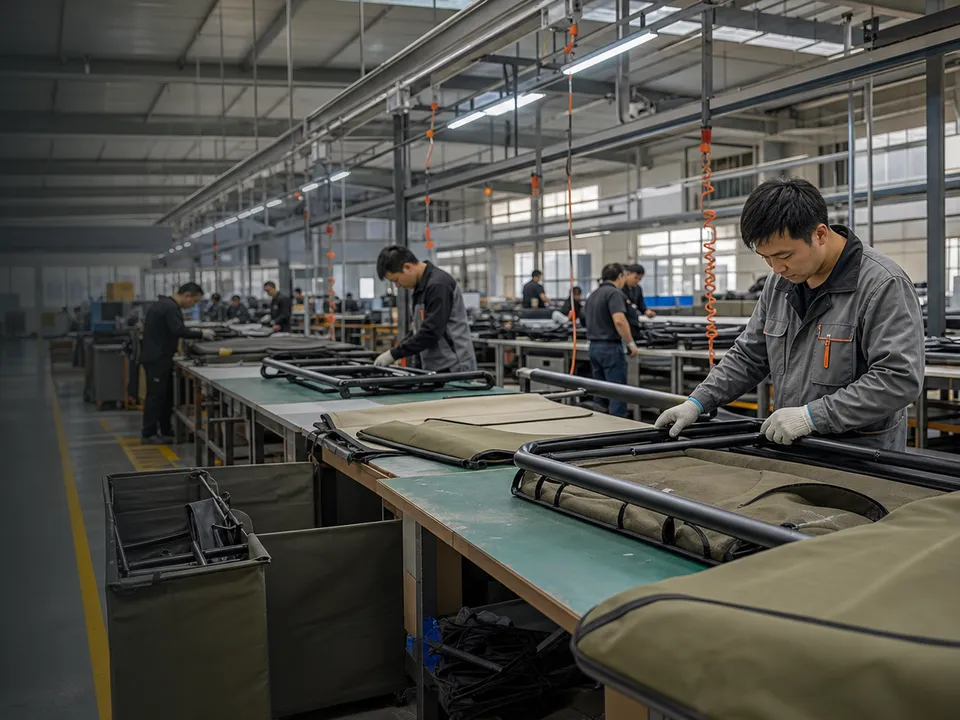
The cost of a custom outdoor product is the result of a specification, process and commercial plan. A target price without those inputs is only a guess.
For a useful quotation, the buyer and manufacturer need to agree on what is being made, how it will be verified, how many units will be ordered and what is included in the price.
Material selection and yield
Materials often form a large share of product cost. The impact is not limited to the price per meter or kilogram.
Cost is affected by:
- Material grade and construction
- Custom color or finish
- Supplier minimum order quantity
- Cutting yield and scrap
- Defect allowance
- Required batch testing
- Storage and handling
- Currency and commodity changes
A small pattern change can sometimes improve fabric yield. Conversely, an unusual color may force the factory to buy more material than the order consumes. Ask whether the quotation assumes a stock material or a custom mill run.
Construction and labor
Labor cost is driven by time, skill, process steps and consistency requirements.
For sewn products, seam type, reinforcement, binding, zipper length, webbing attachments and inspection points all matter. For framed products, forming, welding, surface finishing, hardware installation, alignment and assembly can dominate.
Count operations rather than visual features. A “simple” organizer with many pockets and reinforcements may require more work than a larger but straightforward bag.
Components and supply-chain complexity
Each buckle, foot, hinge, fastener, connector and label adds purchase, handling and quality-control work. Custom components can also create tooling and minimum-order commitments.
Standardizing components across a range may improve purchasing power, reduce spare-part complexity and simplify inspection. It should be done only when the component is appropriate for every application.
Tooling and development charges
One-time costs may include:
- Patterns and engineering work
- Molds and dies
- Jigs and fixtures
- Printing screens or plates
- Prototype materials and labor
- Special test fixtures
- Packaging cutting dies
Confirm whether tooling is charged separately or amortized into the unit price. Record ownership, maintenance, expected life and storage terms.
A low initial tooling charge can be misleading if the project later needs several revisions. Define the prototype scope using our sampling guide.
Quantity, MOQ and variant count
Order quantity affects the unit cost by spreading setup, changeover, material booking and quality activities. But total quantity is not the only number.
Ten colors of 100 units each may cost more than one color of 1,000 units because each color requires material, setup, identification and packing control. Logo variations and market-specific packaging can create the same effect.
Read what determines MOQ for custom camping products to understand the constraint behind the quoted quantity.
Quality assurance, testing and compliance
Quality costs should be planned, not removed from the quotation and discovered after a failure.
Depending on the product, the budget may include:
- Material verification
- Development testing
- Laboratory reports
- Production fixtures and checks
- Third-party inspection
- Compliance documentation
- Reinspection after corrective work
The appropriate level depends on product risk, claims, destination market and customer requirements. Testing every possible property is inefficient; ignoring the critical ones is expensive.
Branding and packaging
Logo method, color count, position and substrate affect setup and reject risk. Packaging cost can include retail boxes, inserts, manuals, labels, barcodes, protective materials, master cartons and pallet requirements.
Packaging also affects freight and fulfillment. A slightly more expensive fold or knock-down design may reduce packed volume enough to improve landed economics.
Use our private label packaging guide to define protection and sales requirements together.
Delivery terms and quotation scope
Prices can be quoted under different Incoterms and may include different transport stages. Confirm:
- Named Incoterm and location
- Export packaging
- Inland transport
- Customs documentation
- Freight and insurance
- Duties and taxes
- Destination delivery
Compare quotations at the same point in the supply chain. A factory price and a delivered price are not alternatives until their scope is normalized.
Cost of change and uncertainty
Late changes create hidden cost through unused materials, repeated samples, line disruption, new artwork and delayed shipment. An incomplete brief may lead the supplier to include a risk allowance or quote an unrealistically narrow scope.
You can reduce uncertainty by freezing:
- Product specification
- Approved sample
- Material references
- Branding artwork
- Packaging
- Inspection criteria
- Order quantity by variant
- Delivery terms
Build a should-cost comparison
You do not need access to a factory's confidential cost sheet. Create a structured comparison of the main drivers:
| Cost block | Comparison questions |
|---|---|
| Materials | Are grade, weight, coating and color assumptions equal? |
| Labor | Is construction and reinforcement the same? |
| Components | Are hardware and finishes equivalent? |
| Tooling | What is included, owned and reusable? |
| Quality | Which tests and inspections are included? |
| Packaging | Is retail and export packaging fully defined? |
| Commercial | Are quantity, payment and delivery terms aligned? |
If a price difference cannot be explained, ask for clarification before negotiating.
Reduce cost through design discipline
Cost engineering should preserve the customer promise. Possible levers include using a proven material construction, reducing unnecessary color variants, simplifying hidden features, standardizing hardware, improving cutting yield and optimizing packed dimensions.
Avoid reducing wall thickness, reinforcement, coating or quality checks without evaluating the effect on performance and claims.
For a comparable quotation, send a project brief with the product, quantity, destination, customization and packaging expectations. Our OEM and ODM process shows where cost decisions should be closed.